ChatGPT Search Optimization in 2026: How to Get Your Website Cited in AI Answers
Something shifted in search behavior over the last two years — quietly at first, then all at once.
People stopped opening five browser tabs and scanning through results. Instead, they started typing questions into ChatGPT and reading the answer it assembled. No clicking. No comparing. Just a complete, confident response — with sources cited at the end, like footnotes in a research paper.
For most businesses, this created an invisible problem. Your website could rank on Google's page one and still be completely absent from the ChatGPT answers your potential customers are reading every day. Two entirely different systems. Two entirely different ways of deciding who gets cited — and who gets ignored.
This guide explains exactly how ChatGPT Search works, why it's different from Google, which signals actually drive citations in 2026, and what you need to do — step by step — to get your business into those AI-generated answers before your competitors figure this out.
What Is ChatGPT Search?
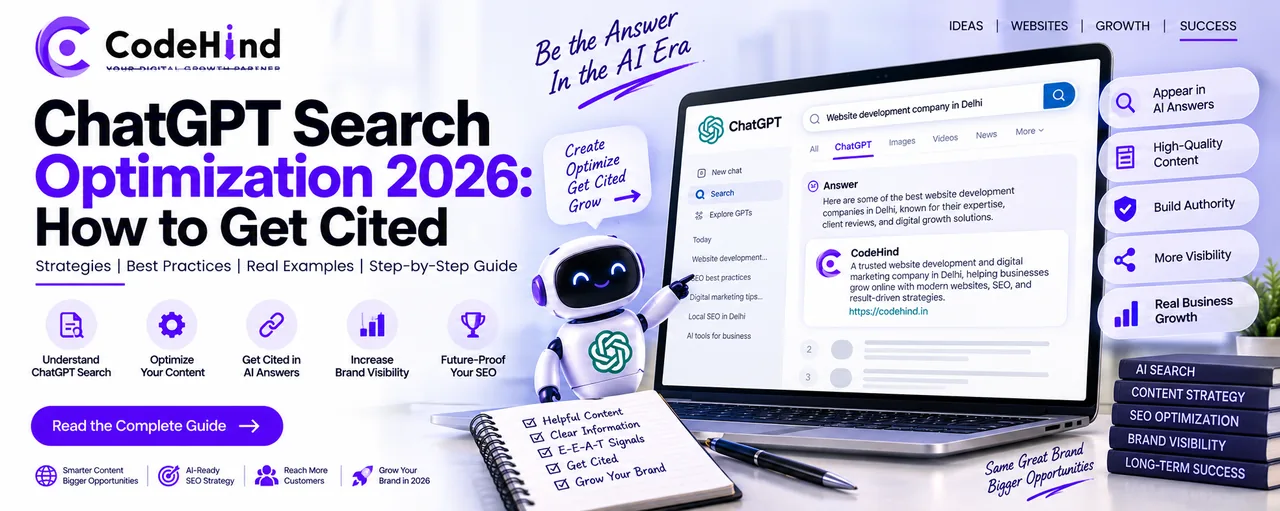
ChatGPT Search is OpenAI's live web search feature inside ChatGPT, which allows the model to retrieve current web pages in real time and cite them as sources inside its generated responses.
Unlike asking ChatGPT a question based on its training data alone (where the answer comes from what the model learned during training and stops at a knowledge cutoff), ChatGPT Search actively fetches live pages at the moment of the query — the way a researcher would look something up, read three or four sources, and synthesize an answer.
The result is a conversational response with numbered citations at the end. The cited pages earn a brand mention, a link, and — importantly — a positioning as a trusted authority in the user's mind, even if they never click through to the actual website.
For businesses, this matters for one reason: <u>the users asking ChatGPT questions are often high-intent buyers.</u> They're asking "best digital marketing agency in Delhi," "which SEO company should I hire," "website development cost in Delhi" — the exact queries that, on Google, would send them to your service page. On ChatGPT, those queries lead to an AI-generated recommendation — and if your business isn't in that answer, you don't exist.
How ChatGPT Search Actually Works (The RAG Pipeline)
Most optimization advice skips over this part, which is why most of it is incomplete. Understanding the technical mechanism tells you exactly where to intervene.
ChatGPT Search operates on a Retrieval-Augmented Generation (RAG) architecture. This is not one process — it's at minimum four distinct stages, and your content competes differently at each one.
Stage 1: Query Rewrite and Fan-Out
When a user submits a prompt, ChatGPT doesn't search for it verbatim. <u>Research shows that 89.6% of ChatGPT Search prompts trigger two or more additional sub-searches before an answer is returned.</u> The model rewrites the original query into multiple related searches — this is called fan-out.
Example: A user asks "how much does website development cost in Delhi?"
ChatGPT internally generates sub-queries such as: "website development price Delhi 2026," "web design agency cost India," "WordPress website cost small business Delhi," and possibly "hidden costs of website development."
Each of those sub-queries becomes a separate retrieval call. Your content gets evaluated against all of them.
What this means for you: Content that only answers the surface question ("website development costs ₹X") is less competitive than content that also covers the related sub-questions users don't explicitly ask — maintenance costs, domain and hosting, GST, comparison between options. Semantic completeness wins citations.
Stage 2: Candidate Retrieval
ChatGPT Search retrieves candidate pages primarily from Bing's search index, supplemented by OpenAI's own proprietary crawl index. This is one of the most important practical differences from Google AI Overviews, which uses Google's index.
<u>About 87% of ChatGPT's citations overlap with Bing's top 10 results for the same query,</u> according to BenchLM's 2026 AEO analysis. This means: if your site isn't indexed and ranking in Bing, your chances of appearing in ChatGPT Search are significantly reduced — regardless of how well you rank on Google.
Many businesses have never set up Bing Webmaster Tools. This is a straightforward fix that your competitors are probably not doing.
Stage 3: Passage Scoring
Once candidate pages are retrieved, ChatGPT scores individual passages — not entire pages — based on how directly, clearly, and completely they answer the specific sub-query. A self-contained 50–70 word passage that directly answers a question in plain language scores significantly higher for extraction than the same information buried inside a long paragraph.
<u>Research from SE Ranking's 2025–2026 study of 400,000 URLs found that content structure is one of the three strongest predictors of ChatGPT citations,</u> alongside domain authority and content freshness.
Stage 4: Synthesis and Citation Selection
Finally, Gemini (or in ChatGPT's case, GPT-4o) synthesizes the retrieved passages into a coherent answer and selects 3–8 sources to cite. At this stage, trust signals, entity clarity, and corroboration across multiple sources determine which pages make the final citation list.
Pages that are independently mentioned, reviewed, or referenced on other sites ChatGPT already trusts get a significant advantage here — because the model is risk-averse. It prefers citing sources with corroboration over sources it can only validate from their own content.
ChatGPT Search vs. Google Search: The Critical Differences
| Factor | Google Search | ChatGPT Search |
|---|---|---|
| Index source | Google's own index | Bing index + OpenAI proprietary index |
| Result format | List of links | Synthesized answer + cited sources |
| Ranking determines citation? | Mostly — AIO comes from top 10 | Partially — 12% of cited URLs don't rank in Google top 10 |
| User action after answer | Usually clicks a link | Often reads without clicking |
| Crawler for search | Googlebot | OAI-SearchBot, ChatGPT-User |
| Crawler for training | Google-Extended | GPTBot |
| Key citation driver | Organic ranking, E-E-A-T | Authority threshold + structure + Bing ranking |
| Fan-out queries? | No (single query) | Yes — multiple sub-searches per prompt |
| Schema benefit | Rich results + AIO | Parseability + entity recognition |
The most important row in that table: <u>44% of SaaS brands with strong Google rankings have zero ChatGPT visibility.</u> (EMGI Group, April 2026.) Google SEO is necessary but not sufficient. You need a parallel ChatGPT-specific strategy.
ChatGPT Search Ranking Factors in 2026
Based on the SE Ranking 400,000-URL analysis, BenchLM's AEO research, and multiple independent citation studies, here are the verified and inferred ranking factors — labeled honestly for what the evidence actually supports.
✅ Documented: Domain Authority (Trust Threshold)
<u>Sites with over 32,000 referring domains are 3.5x more likely to be cited by ChatGPT than sites with fewer referring domains.</u> (SE Ranking, November 2025.)
This doesn't mean you need 32,000 backlinks — it means authority functions as a trust gate. In traditional SEO, moderate-authority sites could rank for long-tail keywords on content relevance alone. ChatGPT is more risk-averse: it strongly prefers citing sources it has external corroboration for.
For small and medium businesses, this points to a critical insight: you can't buy your way to ChatGPT citations with links alone. But you can build meaningful authority through a smaller number of genuinely relevant mentions — local directories, industry publications, real client reviews, partner websites, and local news coverage. Quality and relevance of sources matters more than raw quantity at the smaller scale.
✅ Documented: Answer-First Extractable Content Structure
Every independent study points here. Passages that provide a direct, complete answer in the first 40–70 words of a section — before the explanation, before the caveats — are significantly more likely to be extracted.
This is the "inverted pyramid" writing structure: conclusion first, then supporting detail. It's how journalists are trained to write, and it turns out it's exactly what RAG systems are built to prefer.
✅ Documented: Content Freshness
<u>Content freshness is one of the three primary citation drivers across all major AI search platforms.</u> (SE Ranking / AirOps / Authoritas, 2025–2026.) For topics that change over time — prices, strategies, regulations, local service information — ChatGPT retrieves from recently updated sources.
An article with a 2024 publication date and no update timestamp loses citations to an equivalent article updated in 2026, even if the underlying information is similar.
✅ Documented: Schema Markup Parseability
Structured data doesn't directly "rank" you in ChatGPT — but it significantly speeds up the model's ability to understand what your content means, who wrote it, what the questions and answers are, and what entity your business represents. FAQPage, Article, Organization, and LocalBusiness schema are the highest-priority types.
🔍 Inferred: Bing Search Ranking
Given that the primary retrieval index for ChatGPT Search is Bing-backed, pages that rank well in Bing are significantly more likely to enter the candidate pool. This inferred factor has strong observational support — <u>about 87% of ChatGPT cited pages appear in Bing's top 10 for the same query.</u>
🔍 Inferred: Cross-Platform Brand Mentions (Entity Corroboration)
Pages from brands that are independently mentioned, cited, or discussed in sources ChatGPT already trusts earn an implicit authority boost during the synthesis stage. The model is cross-referencing — "is this source someone other sources also recognize?"
This is distinct from traditional link-building. A mention in a credible local news article, a trade directory, or a relevant blog post — even without a dofollow link — contributes to brand entity recognition.
🔍 Inferred: Topical Depth (Fan-Out Coverage)
Because ChatGPT fans out into multiple sub-queries per prompt, sites that have built topic cluster content — pillar page plus many supporting cluster pages on related subtopics — appear in more sub-query retrieval calls and therefore earn more citation opportunities per user prompt.
The Technical Prerequisite: Can ChatGPT Even See Your Website?
Before any content optimization matters, confirm one thing: your robots.txt file is not blocking the AI crawlers that drive ChatGPT Search citations.
This is the single most common reason for zero ChatGPT citations. A line in robots.txt quietly blocking the relevant crawlers makes every other optimization effort pointless.
OpenAI operates two distinct crawlers with different purposes:
- OAI-SearchBot — retrieves pages for ChatGPT Search citations. You want this allowed.
- GPTBot — crawls pages for model training. Blocking this is your choice and will not remove you from ChatGPT Search citations — but allowing it feeds ChatGPT's background knowledge of your brand.
- ChatGPT-User — real-time fetches triggered by live user requests. Should be allowed.
For comprehensive AI search visibility across platforms, your robots.txt should explicitly allow:
# Allow ChatGPT Search citation crawlers
User-agent: OAI-SearchBot
Allow: /

User-agent: ChatGPT-User
Allow: /

User-agent: GPTBot
Allow: /

# Allow Perplexity
User-agent: PerplexityBot
Allow: /

User-agent: Perplexity-User
Allow: /

# Allow Anthropic (Claude Search)
User-agent: ClaudeBot
Allow: /

User-agent: Claude-SearchBot
Allow: /

# Allow Google AI (Gemini / AI Overviews)
User-agent: Google-Extended
Allow: /
Important distinction from the 2026 research: Training crawlers (GPTBot, ClaudeBot, Google-Extended) and search/RAG crawlers (OAI-SearchBot, PerplexityBot, Claude-SearchBot) are separate. You can block AI training while staying eligible for AI search citations — they're independent directives. Decide your policy for each separately.
What About llms.txt?
The honest 2026 answer: don't prioritize it.
An analysis of 515 million LLM bot traffic events filtered specifically for the crawlers that drive AI search citations (GPTBot, OAI-SearchBot, PerplexityBot, ClaudeBot, Google-Extended) found that <u>requests to llms.txt were a statistically negligible share of total crawl traffic.</u> (Limy.ai, May 2026.)
Google has stated it doesn't use llms.txt for Search or AI Overviews. OpenAI and Anthropic haven't confirmed it as a citation signal. Any agency selling llms.txt as a primary GEO ranking lever is selling you something the data doesn't support. Focus on the factors with documented impact first.
Step-by-Step: How to Optimize Your Website for ChatGPT Search
Step 1: Set Up and Fix Bing Webmaster Tools
Since ChatGPT Search pulls primarily from Bing's index, Bing Webmaster Tools is your single most overlooked asset for ChatGPT visibility.
- Go to bing.com/webmasters and verify ownership of your site
- Submit your XML sitemap
- Check the Index Explorer for crawl errors or blocked pages
- Review the new "AI Performance" section in Bing Webmaster Tools, which shows impressions from Microsoft's AI surfaces (Copilot, Bing AI summaries)
- Fix any crawl errors that appear — errors on Bing often explain why ChatGPT isn't finding your content
Most Delhi NCR businesses have never opened Bing Webmaster Tools. This alone puts you ahead of 90% of local competitors for ChatGPT Search visibility.
Step 2: Restructure Your Key Pages with Answer-First Sections
For every major H2 section on your important pages, apply this format without exception:
Question-form heading → 40–70 word direct answer → In-depth explanation → Supporting bullet list or table
The 40–70 word direct answer must be self-contained — it should make complete sense if a reader only reads that one paragraph and nothing else. This is exactly the passage size and structure that ChatGPT's extraction mechanism is designed to lift cleanly.
Wrong:
"Website development is a complex process that involves multiple stages including discovery, design, development, and launch. The cost depends on many factors..."
Right:
"A professional business website in Delhi costs ₹40,000–₹1,20,000 in 2026, depending on page count, design complexity, and features required. Ecommerce websites start at ₹80,000. Custom web applications start at ₹2,00,000. All prices exclude 18% GST."
The second version is citable. The first one isn't.
Step 3: Build and Optimize Topic Clusters
Because ChatGPT fans out every query into multiple sub-searches, a single excellent page is significantly less competitive than a cluster of 8–12 interlinked pages covering a topic from every angle.
For a digital marketing agency in Rohini, that means not just one "SEO services" page but a full cluster:
- Pillar: "SEO Services for Delhi Businesses — Complete Guide"
- Cluster: "Local SEO in Delhi," "Google Business Profile Setup," "Technical SEO Audit Checklist," "SEO Cost in Delhi 2026," "On-Page SEO Guide," "Link Building for Indian Businesses," "SEO for Small Businesses in Rohini"
Every cluster page links to the pillar. The pillar links to all clusters. This architecture means that no matter which sub-query ChatGPT fans out into around "SEO in Delhi," one of your pages is a candidate.
Step 4: Implement the Full Schema Stack
At minimum for ChatGPT optimization:
Organization / LocalBusiness (on every page via site-wide <head>): Establishes your business entity, address, phone, service area, and sameAs links to your verified social profiles. This is the primary entity signal ChatGPT uses to understand who you are.
Article / BlogPosting (on all blog content): Includes named author, datePublished, dateModified, and publisher. ChatGPT's risk-aversion means it prefers content from identified humans with verifiable credentials over anonymous "Admin" posts.
FAQPage (on all pages with Q&A content): Makes question-answer pairs machine-readable so ChatGPT can parse them without having to infer structure from HTML.
HowTo (on step-by-step instructional content): ChatGPT frequently cites structured how-to content for process-oriented queries.
Step 5: Build Your Brand's External Footprint
ChatGPT corroborates sources by cross-referencing them. A brand that's mentioned, cited, or reviewed on sources ChatGPT already trusts is significantly more likely to be selected as a citation.
Priority actions for Delhi NCR businesses:
Local directories: Justdial, IndiaMART, Sulekha, Yellow Pages India, Practo (for healthcare), Shiksha (for education) — consistent NAP (name, address, phone) across all of them
Google Business Profile: Keep it fully updated — it feeds into both Google and Bing's local entity data, which flows into ChatGPT's understanding of local businesses
Google Reviews: Reviews contain natural language that describes what your business does and where — ChatGPT reads these when assembling local recommendations
Industry publications and local news: Even one genuine feature or mention in a credible Delhi-area publication carries significant corroboration weight
LinkedIn: A fully completed company page with regular posts builds brand entity signals that AI systems cross-reference
Step 6: Establish Named Author Authority
<u>The vast majority of ChatGPT-cited pages come from sources with identifiable, credible authors</u> — not anonymous content.
For every important piece of content, you need:
- A real name in the byline
- A 3–5 sentence author bio with genuine credentials ("10 years in digital marketing, formerly at X, worked with 50+ Delhi NCR businesses")
- A dedicated author page collecting all content by that person
Personschema on the author page linking to their LinkedIn and other verified profiles
This is not just a nice-to-have. It's a documented E-E-A-T signal that ChatGPT's trust evaluation process weighs when selecting between otherwise equivalent sources.
Step 7: Maintain a Content Freshness Schedule
Set up a quarterly review calendar for your 10–15 most important pages. In each review:
- Update any statistics older than 12 months
- Check that prices, service descriptions, and contact details are current
- Update the
dateModifiedfield in your Article schema to the actual date of the update (not a fake date — ChatGPT can cross-check) - Add any new, relevant information from the last quarter
- Review internal linking to ensure new cluster pages are linked in
Step 8: Write for Questions People Actually Ask
ChatGPT queries are fundamentally conversational. People ask full questions — not keyword fragments. Your content needs to match that language naturally.
Use tools like Google Search Console (for "People Also Ask" related queries), keyword tools for question-form variants, and simply type your topic into ChatGPT itself to see what sub-questions it generates. Those sub-questions are the fan-out queries your content needs to cover.
H2 and H3 headings phrased as questions — "How long does SEO take to show results?" "What is the cost of a website in Delhi?" — directly match the query rewrite patterns ChatGPT uses in Stage 1 of its retrieval pipeline.
Why Your Competitor's Website Gets Cited and Yours Doesn't
Here are the most common, concrete reasons ChatGPT ignores a website even when the content is strong:
1. AI crawlers blocked in robots.txt The most common cause. Check your robots.txt at yourdomain.com/robots.txt and verify OAI-SearchBot, ChatGPT-User, and Bingbot are allowed.
2. Site not indexed in Bing Ranking in Google doesn't automatically mean Bing has indexed your site. Check Bing Webmaster Tools. If your pages aren't in Bing's index, they aren't candidates for ChatGPT Search retrieval.
3. Content rendered by JavaScript Pages where the core content only loads after JavaScript executes are either partially or fully invisible to AI crawlers. Critical content must appear in the raw HTML source.
4. No named authors or author authority Anonymous content is treated as lower-trust. Add real bylines to every piece of content that could earn citations.
5. No schema markup Without structured data, ChatGPT's parser has to guess at what your content means — what the entities are, who wrote it, what the Q&As are. Schema removes that guesswork.
6. Thin topical coverage One page on a subject doesn't build topical authority. ChatGPT favors sources with demonstrated depth across a topic — which means topic clusters, not standalone articles.
7. No external corroboration A brand that appears only on its own website is harder for ChatGPT to trust than one that's mentioned across directories, reviews, partner sites, and publications. Build that external footprint deliberately.
8. Zero information gain ChatGPT actively deprioritizes content that's essentially a rewrite of what's already said everywhere else. Original data, first-person expertise, client examples, and local market insights — things a competitor can't copy — give your content genuine information gain that AI systems recognize and prefer.
Common Myths About ChatGPT SEO in 2026
Myth 1: "I need to rank #1 on Google first." Helpful but not mandatory. <u>About 12% of URLs cited by ChatGPT don't rank in Google's top 10 for the same query.</u> ChatGPT has its own retrieval layer and can surface pages Google ranks lower, especially for niche or locally specific queries where your content is uniquely relevant.
Myth 2: "llms.txt will get me cited." Not according to the data. As analyzed above — statistically negligible impact on citation rates from the crawlers that actually matter. Don't make it a priority.
Myth 3: "Long content always wins." Not in the AI citation game. What wins is structured, extractable content. A 600-word page with perfect answer-first structure can outperform a 3,000-word article that buries its answers in mid-paragraph.
Myth 4: "ChatGPT optimization is different from SEO." They're distinct but deeply overlapping. <u>About 87% of ChatGPT cited pages appear in Bing's top-10 for the same query.</u> Strong technical SEO, topical authority, E-E-A-T, and quality content drive both. ChatGPT optimization adds specific layers — Bing submission, answer-first structure, robot.txt audit, entity building — on top of solid SEO foundations.
Myth 5: "Only big brands can appear in ChatGPT answers." <u>The authority trust threshold matters more for entry into the candidate pool than for selection within it.</u> For locally-specific or niche queries, smaller businesses with genuinely relevant, well-structured content regularly outperform large brands with generic coverage. A Delhi-based digital marketing agency giving specific, local advice on ranking in Delhi is more citable for that query than a global agency with vague, universal content.
ChatGPT Search Optimization Checklist for 2026
Technical Foundation ✓
- OAI-SearchBot and ChatGPT-User allowed in robots.txt
- GPTBot decision made and implemented in robots.txt
- PerplexityBot, ClaudeBot, Google-Extended policy set
- Site verified and sitemap submitted in Bing Webmaster Tools
- AI Performance report checked in Bing Webmaster Tools
- Core content in HTML source (not JavaScript-dependent)
- HTTPS active, no crawl errors, no broken internal links
- XML sitemap current and submitted to both Google and Bing
- Mobile-responsive, Core Web Vitals passing
Content Structure ✓
- Every H2 section starts with a 40–70 word direct answer
- Section headings phrased as questions where appropriate
- Content covers topic fan-out sub-questions, not just head keyword
- Short, readable paragraphs (3–5 sentences max)
- Bullet lists for multi-item information
- Comparison tables where relevant
- No keyword stuffing, no generic AI-sounding phrases
Schema Markup ✓
- Organization / LocalBusiness schema (sitewide)
- Article / BlogPosting schema with author and dateModified
- FAQPage schema on all Q&A content
- HowTo schema on step-by-step guides
- Person schema on all author pages
- Schema validated with Google's Rich Results Test
Author Authority ✓
- Every important piece of content has a named human author
- Author bio includes specific credentials and experience
- Dedicated author page linking all content by that person
- Author pages include Person schema with LinkedIn link
Entity and External Footprint ✓
- Google Business Profile 100% complete and regularly updated
- NAP consistent across 10+ local directories
- 20+ genuine Google reviews with keyword-relevant text
- LinkedIn company page complete with regular posts
- At least 1–2 genuine external mentions (local press, industry sites)
Content Freshness ✓
- Quarterly review calendar created for priority pages
- dateModified in schema updated on actual edit dates
- Statistics and examples refreshed to current year
- Outdated claims or prices removed or corrected
FAQ Section (10 Questions — Schema-Ready)
Q1: What is ChatGPT Search optimization? ChatGPT Search optimization is the practice of structuring, formatting, and positioning your website and content so that ChatGPT's live web search feature retrieves and cites your pages when generating answers to user queries. It combines traditional SEO foundations with additional techniques — answer-first content structure, Bing indexation, entity building, and schema markup — to improve the probability that ChatGPT selects your site as a citation source.
Q2: Is ChatGPT Search the same as Google SEO? No, though they share important foundations. ChatGPT Search retrieves pages primarily from Bing's index rather than Google's, uses a RAG pipeline that fans out every query into multiple sub-searches, and weighs content structure and entity corroboration more heavily than traditional keyword-based ranking signals. About 44% of brands with strong Google rankings have no ChatGPT visibility at all, which means Google SEO alone is not sufficient for ChatGPT citation.
Q3: How do I check if ChatGPT can access my website? Check your robots.txt file (at yourdomain.com/robots.txt) and verify that OAI-SearchBot and ChatGPT-User are not blocked. Then verify your site is indexed in Bing via Bing Webmaster Tools (bing.com/webmasters). If your key pages don't appear in Bing search results, they are not candidates for ChatGPT Search retrieval.
Q4: Do I need to block GPTBot to protect my content? Blocking GPTBot prevents your content from being used to train future OpenAI models but does not remove you from ChatGPT Search citations — the search crawler (OAI-SearchBot) is separate and independently controlled. Whether to block GPTBot is a business decision about training data permissions, not a citation strategy decision.
Q5: How long does it take to start appearing in ChatGPT Search results? There's no guaranteed timeline. Businesses implementing a complete strategy — Bing submission, robots.txt fix, schema markup, answer-first restructuring, and external entity building — typically begin seeing citation patterns within 6–12 weeks for specific queries, with more consistent visibility at 3–6 months. Highly competitive queries take longer and require stronger domain authority signals.
Q6: Does schema markup guarantee ChatGPT citations? No. Schema markup is a documented citation signal — it makes your content significantly easier to parse and extract — but it's one factor among many. It works best when combined with strong content structure, topical authority, Bing indexation, and external entity corroboration.
Q7: Can a small local business in Delhi appear in ChatGPT answers? Yes — and local or niche specificity is actually an advantage. For locally-specific queries ("best SEO company in Rohini," "website development cost Delhi"), a smaller agency with locally-relevant, well-structured content is often more citable than a large national brand with generic coverage. The authority trust threshold matters most for broad, competitive queries; local specificity can compensate for lower overall domain authority.
Q8: What is the "fan-out" process in ChatGPT Search? Fan-out refers to ChatGPT's process of rewriting a single user query into multiple related sub-searches before returning an answer. For example, "SEO services Delhi" might fan out into "local SEO Delhi companies," "SEO pricing India 2026," "how to choose SEO agency Delhi," and others. About 89.6% of ChatGPT prompts trigger two or more sub-searches. This means content covering a topic's full range of related questions — not just the head keyword — earns more citation opportunities per user prompt.
Q9: Is Bing Webmaster Tools important for ChatGPT optimization? Yes — it's one of the most underused tools for ChatGPT visibility. Since ChatGPT Search retrieves primarily from Bing's index, verifying your site in Bing Webmaster Tools, submitting your sitemap, and fixing any Bing-specific crawl errors directly improves your eligibility for ChatGPT Search citations. Most businesses in India have never opened Bing Webmaster Tools, making this a significant competitive gap to close.
Q10: What content format does ChatGPT prefer to cite? ChatGPT favors content with direct, complete answer passages in the first 40–70 words of each section; question-form headings that match natural language query patterns; bullet points and tables for multi-item information; verified author credentials; updated publication dates; and FAQPage or Article schema markup. Generic, keyword-stuffed, or wall-of-text content without clear answer structure is significantly less likely to be cited regardless of other ranking signals.
Ready to Get Cited in ChatGPT, Gemini, and Perplexity?
Most businesses in Delhi NCR are still optimizing only for traditional Google rankings — and getting left behind as their potential customers switch to asking AI instead.
ChatGPT Search, Google AI Overviews, and Perplexity don't replace Google. They run alongside it. And right now, in most local markets, the competition for AI citations is lower than the competition for traditional rankings — which means this is the best window you'll have to establish your brand as a trusted AI-cited source before your competitors figure it out.
At CodeHind, we build complete AI search visibility strategies for businesses across Rohini, Pitampura, and Delhi NCR — combining solid technical SEO foundations with the entity-building, schema, content structure, and Bing optimization work that drives real ChatGPT and AI Overview citations.
→ Book Your Free AI Search Visibility Audit
We'll show you exactly where your website stands across ChatGPT, Google AI Overviews, and Perplexity — and what it will take to get you cited consistently.
CodeHind — Digital Marketing & Website Development Agency Sector-20, Rohini, New Delhi 110086 | +91 7292039626