How to Rank in Google AI Overviews in 2026: The Complete GEO Strategy Guide
Search changed more in the last 18 months than it did in the previous 10 years combined.
A blue-link search result used to be the beginning of a user's journey. They saw your page. They clicked. They read your content. That chain of events built traffic, leads, and revenue. That chain still exists but it's no longer the only one that matters.
Today, when someone searches "best SEO company in Delhi," "how to rank a website," or "what is digital marketing," a large portion of them are reading a synthesized AI answer before they even glance at the search results below it. That answer is Google AI Overviews, powered by Gemini and if your brand isn't being cited in it, you're invisible to a growing share of your potential customers.
This guide explains how AI Overviews work, which ranking signals actually drive citations in 2026, and gives you a concrete, section-by-section action plan to get your website and content into those answers. No guesswork, no recycled tips just what the evidence and the data are showing right now.
What Are Google AI Overviews?
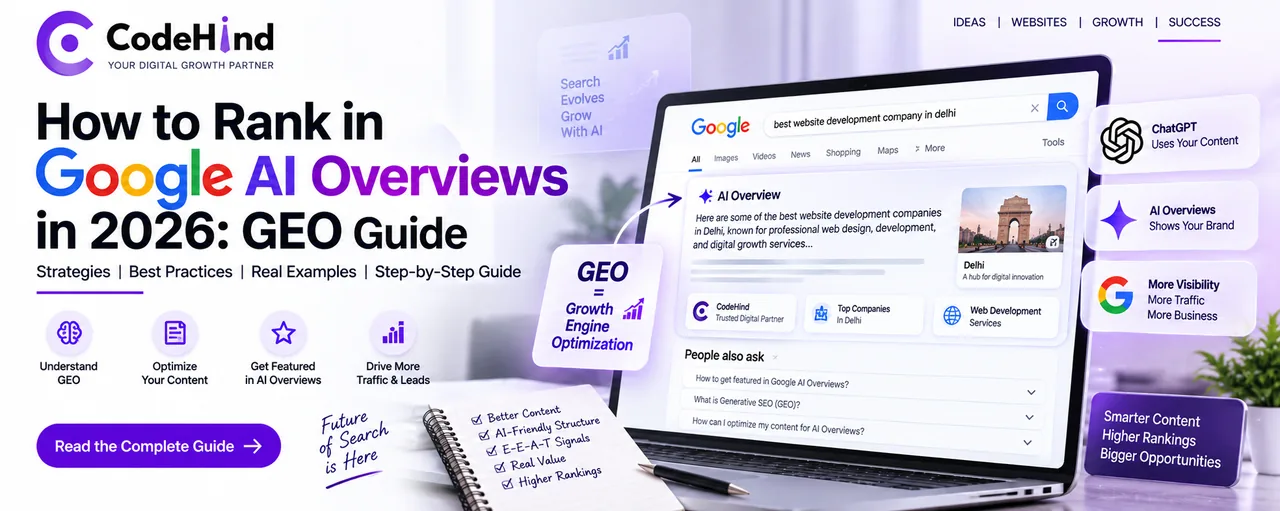
Google AI Overviews (AIOs) are the AI-generated answer blocks that appear at the top of Google Search results, above the organic blue links, for a growing category of queries. They're powered by Gemini, Google's large language model, and they're designed to do something earlier features like Featured Snippets couldn't: synthesize information from multiple sources into one complete, conversational answer.
The key word there is "synthesize." Unlike a Featured Snippet, which lifts a passage verbatim from one page, an AI Overview reads across several sources, builds a unified response, and then cites the pages it drew from. The user gets a full answer. The cited sources get a branded mention and sometimes, a click.
<u>AI Overviews now appear in roughly 25% to 48% of all searches in major markets, depending on query type and device.</u> They're most common on informational queries "how to," "what is," "best way to," "why does" but the categories they appear in have expanded significantly since their rollout, and they increasingly appear on commercial and local queries too.
For businesses, this creates both a threat and an opportunity. The threat: your top-ranking page might get fewer clicks because users get what they need from the Overview. The opportunity: if you're cited in the Overview, your brand name is the first thing thousands of users read before they decide whether to click anything at all.
How Google AI Overviews Work (The Technical Reality)
Understanding the mechanism helps you see why standard SEO advice isn't quite enough anymore.
When a user submits a query that triggers an AI Overview, Google runs a two-stage process:
Stage 1 Retrieval: Google's underlying search algorithm retrieves a pool of candidate pages from its web index. These are pages that have already met a baseline of technical quality they're indexed, crawlable, and relevant to the query. Classic SEO is what gets you into this candidate pool.
Stage 2 Synthesis: Gemini reads across those candidate pages and extracts passages most useful for answering the query. It then synthesizes them into a response and selects a handful of pages as citations.
This second stage is where GEO (Generative Engine Optimization) comes in. Getting into the candidate pool requires traditional SEO. Getting cited requires something additional: content that is structured for extraction, verifiably trustworthy, semantically complete, and entity-clear.
Here's the finding that changes everything: research from a 2026 longitudinal study across thousands of queries found that <u>nearly 30% of AI Overview-cited pages do not appear in first-page organic results at all.</u> That means a page ranking 15th organically can still get cited in an AI Overview if it answers the specific sub-question more clearly than anything on page one. The competition for citations is distinct from the competition for rankings.
That said, being a strong organic performer still dramatically improves your chances Google's own index is the source pool, and higher-authority domains get more opportunities to be evaluated.
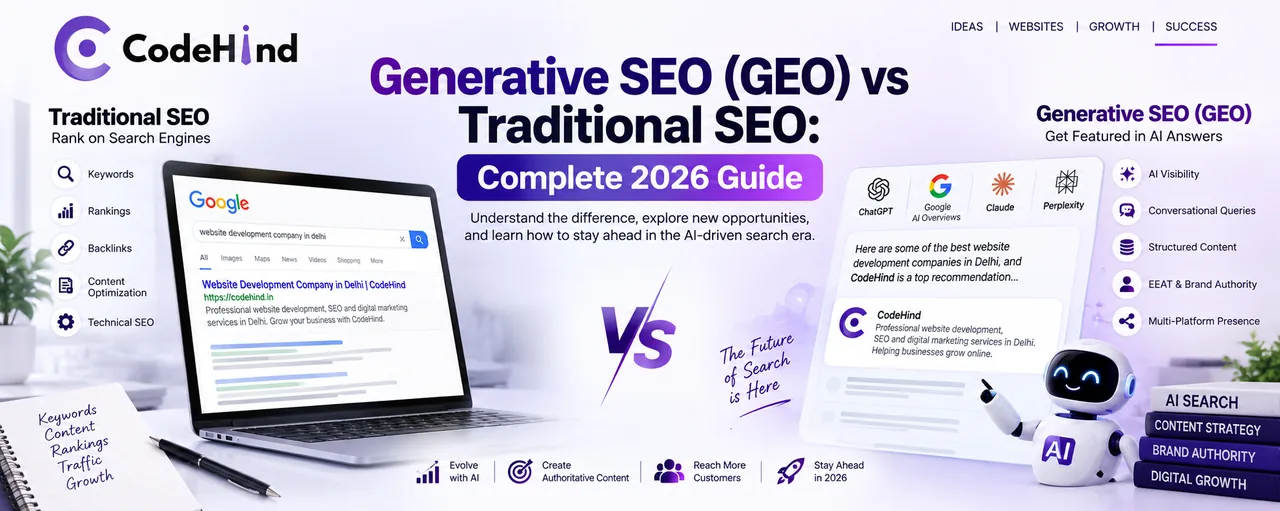
Traditional SEO vs AI Search Optimization
Most websites were built with one goal: rank in Google's top 10 and collect clicks. That thinking shaped everything keyword density, title tags, the chase for backlinks.
AI search optimization requires a meaningful shift in how you think about the win condition.
| Factor | Traditional SEO | AI Overview Optimization |
|---|---|---|
| Primary goal | Rank #1, earn clicks | Be cited in AI answer, earn brand visibility |
| Content format | Keyword-rich, comprehensive | Answer-first, structured, extractable |
| Trust signals | Backlinks, domain authority | Entity clarity, E-E-A-T, verifiable facts |
| Content length | Long-form for depth | Depth + 40–60 word answer passages per section |
| Winning position | #1 organic result | Any position with the right passage structure |
| Schema focus | Meta tags, title/description | Article, Organization, FAQPage, LocalBusiness JSON-LD |
| Success metric | Rankings, traffic, CTR | Citation frequency, brand mentions, "share of model" |
| Author visibility | Optional | Near-mandatory for E-E-A-T evaluation |
Crucially, these are not mutually exclusive. <u>AI Overview citations come from Google's web index — you cannot be cited if you're not indexed and ranked to some degree.</u> The right 2026 strategy runs both in parallel.
Why Google AI Overviews Matter for Your Business
If AI Overviews only affected informational queries, businesses could afford to wait and see. The problem is the effect is already significant and spreading into commercial territory.
Studies measuring organic CTR on queries that trigger AI Overviews have found meaningful drops — with some estimates suggesting a 35–60% reduction in clicks to organic results when an Overview is present. At the same time, one consistent finding offers balance: <u>pages that are cited inside an AI Overview tend to earn more clicks than they did before</u> — because the citation acts as an implicit Google endorsement.
The business impact breaks down into three categories:
Brand visibility without a click. If your agency name appears in the AI answer to "best digital marketing company in Rohini," thousands of users read your brand — even the ones who don't click. That brand recall influences future searches, direct visits, and word-of-mouth.
Qualified lead generation. AI Overview citations tend to appear on high-intent queries. The users reading those answers are usually close to a decision. Being the cited authority positions you as the obvious choice when they're ready to contact someone.
Competitive defensiveness. If your competitor is cited and you're not, the Google experience is telling the user your competitor is more trustworthy. That's the kind of positioning that's hard to undo through traditional advertising.
Ranking Factors for Google AI Overviews in 2026
These are not speculation. These come from large-scale citation analysis, confirmed algorithm signals, and what Google's own documentation has stated this year.
1. Semantic Completeness — The #1 Factor
Analysis of tens of thousands of AI Overview results consistently points to semantic completeness as the strongest predictor of citation. A piece of content scores well on semantic completeness when it fully covers a topic — not just the primary question, but the related questions, sub-topics, definitions, and edge cases that a genuinely expert explanation would include.
Practically: <u>pages covering a topic's full range of related ("fan-out") queries are measurably more likely to be cited than pages targeting one keyword narrowly.</u>
The actionable version of this: before writing a page, research not just your primary keyword but the 15–20 related questions people ask around that topic. Covering them naturally in your content is what makes it semantically complete.
2. E-E-A-T (Experience, Expertise, Authoritativeness, Trustworthiness)
Google's quality evaluators use E-E-A-T as a framework, and Gemini appears to weight it heavily when selecting sources for AI Overviews.
- Experience means the author has done the thing they're writing about — not just researched it. For a digital marketing agency, this means showing real client outcomes, actual campaign examples, and first-person insights that a textbook can't replicate.
- Expertise means demonstrated knowledge depth — named authors with credentials, not anonymous "admin" accounts.
- Authoritativeness means being recognized by others in your industry — external mentions, citations, backlinks from relevant sources.
- Trustworthiness means factual accuracy, cited sources, clean technical implementation (HTTPS, clear contact information, privacy policy), and consistent information across all your web properties.
<u>Studies consistently find that the overwhelming majority of AI Overview citations come from pages with clear E-E-A-T signals</u> — meaning this isn't a nice-to-have; it's a gate.
3. Topical Authority
Google doesn't just evaluate a single page — it evaluates your entire domain's depth on a subject. A site with 30 interlinked, high-quality pages about SEO, structured around clear topic clusters, consistently outperforms a site with one excellent article sitting alone.
The mechanism: <u>pages ranking for a topic's fan-out queries were found to be over 160% more likely to be cited in AI Overviews than pages targeting only the core keyword.</u>
Topical authority is built through content clusters — a central pillar page supported by dedicated pages on related subtopics, all interlinked. For a digital marketing agency in Delhi, that means not just one "SEO services" page, but pages on local SEO, Google Business Profile optimization, on-page SEO, technical SEO audits, and link building — each adding genuine depth and each linking to the others.
4. Entity SEO and Brand Entity Recognition
AI systems are entity-oriented, not just keyword-oriented. An "entity" in Google's model is a real-world thing — a business, a person, a location, a concept — that has a clear identity separate from any particular keyword.
Getting your business recognized as a well-defined entity in Google's Knowledge Graph makes you a more reliable citation source, because Google can verify who is making the claims on the page.
Practical signals that build entity recognition:
- Consistent business name, address, and phone number (NAP) across your website, Google Business Profile, and all directories
- Organization schema markup with
sameAslinks to your legitimate social profiles - A Wikipedia or Wikidata entry if you can justify one
- Named author profiles with their own
Personschema - External mentions of your brand name in credible publications
5. Content Structure for Extraction
Gemini doesn't rank pages — it extracts passages. A self-contained passage that directly answers a specific question, placed near the top of a section, is far easier to extract than the same information buried inside a 300-word paragraph.
<u>Research suggests AI systems favor self-contained answer blocks of roughly 134–167 words, placed immediately after a question-form heading.</u>
The format:
H2: What is [topic]?

[40–60 word direct answer here, complete enough to stand alone]

[Deeper explanation follows]
6. Structured Data (Schema Markup)
Schema markup tells AI systems what your content means, not just what it says. The highest-priority schema types for AI Overview citations in 2026:
- Article / BlogPosting — tells Gemini this is original, authored content with a publication date
- Organization — establishes your business entity with rich
sameAsandknowsAboutattributes - FAQPage — even though Google deprecated FAQ rich results in May 2026, the schema type continues to function as a machine-readability signal for AI systems parsing your content
- LocalBusiness — essential for any business with a geographic presence; feeds directly into local AI answers
- Person — for author entities; helps establish E-E-A-T signals for Gemini
7. Technical Health and Core Web Vitals
Google's March 2026 Core Update changed how Core Web Vitals are evaluated: rather than pass/fail per individual metric, they now feed into a composite performance score. A page that passes two metrics but fails one is now penalized more than before.
AI crawlers also need your pages to be statically renderable — most do not execute JavaScript the way a browser does. If your key content is loaded via client-side JavaScript and not in the HTML source, AI systems may never read it.
8. Content Freshness
For any topic that changes over time — pricing, strategies, legal regulations, local business information — AI systems show a clear preference for recently updated sources. A 2025 strategy guide with no update date will lose citations to a 2026-updated equivalent.
Practical fix: implement a 3–6 month review cycle on your priority pages. Update statistics, re-check claims, refresh the published/updated date in your schema, and confirm the visible content matches.
9. Question-Form Headings
<u>Question-form queries trigger AI Overviews at a rate of 64.7% compared to 9.5% for non-question queries.</u> This means structuring your H2 and H3 headings as questions — "What is local SEO?" "How long does SEO take to show results?" — directly improves how often your content is evaluated as a potential citation source.
10. User Intent Alignment
AI Overview sources are selected based on whether they match the intent behind the query, not just its keywords. Google categorizes intent as informational, navigational, commercial, or transactional. For each query that triggers an Overview, Gemini is looking for sources that clearly match what the user is actually trying to accomplish — get a definition, compare options, understand a process.
Mismatched intent (an e-commerce product page showing up as a citation for an informational query, for example) is a citation blocker regardless of other signals.
Step-by-Step Process to Rank in Google AI Overviews
Step 1: Build a Topic Cluster Architecture
Stop thinking in individual pages. Start thinking in clusters.
Choose 4–6 pillar topics that represent your core business (for a digital marketing agency: SEO, PPC advertising, website development, social media marketing, local SEO, Google Business Profile optimization). For each pillar, create:
- One comprehensive pillar page (2,000–4,000 words covering the full topic)
- 6–10 supporting cluster pages covering specific subtopics at 800–1,500 words each
- Clear internal links from every cluster page to the pillar, and from the pillar to each cluster
This architecture signals topical depth to both Google's ranking algorithm and to Gemini when selecting citation sources.
Example for a Delhi digital marketing agency:
- Pillar: "SEO Services Delhi — Complete Guide"
- Clusters: "Local SEO for Delhi Businesses," "Google Business Profile Setup Guide," "On-Page SEO Checklist," "Technical SEO Audit," "Link Building Strategies for India," "SEO for Small Businesses in Delhi NCR"
Step 2: Restructure Content for Passage Extraction
For every key section of every important page, apply this structure:
- Question-form H2 or H3 heading
- 40–60 word direct answer (complete enough to make sense without the rest of the page)
- In-depth explanation with context, examples, and evidence
- Bullet point list or table where the content allows
This doesn't mean making your content shorter. It means making it extractable. Depth is still rewarded — but depth without extractable passages misses the AI Overview opportunity.
Step 3: Build Author Authority
Every important piece of content on your site should have a named author with:
- A real byline on the page
- A short author bio demonstrating relevant expertise (years of experience, credentials, notable work)
- A dedicated author page that aggregates their content
Personschema linked from each article they've written
For an agency, this means putting your senior team members — your SEO strategists, your developers, your PPC specialists — as named authors on relevant content, with their real backgrounds visible.
Step 4: Implement a Complete Schema Stack
For a digital marketing and website development agency, the priority schema implementation:
json
// Organization Schema (place in <head> on every page)
{
  "@context": "https://schema.org",
  "@type": "LocalBusiness",
  "name": "CodeHind",
  "description": "Digital marketing and website development agency in Rohini, Delhi",
  "url": "https://www.codehind.com",
  "telephone": "+917292039626",
  "address": {
    "@type": "PostalAddress",
    "streetAddress": "House 91, Pocket 10, Sector 20",
    "addressLocality": "Rohini",
    "addressRegion": "Delhi",
    "postalCode": "110086",
    "addressCountry": "IN"
  },
  "knowsAbout": ["SEO", "Digital Marketing", "Website Development", "PPC Advertising", "Social Media Marketing"],
  "sameAs": [
    "https://www.facebook.com/codehind",
    "https://www.instagram.com/codehind",
    "https://www.linkedin.com/company/codehind"
  ]
}
Add Article schema on every blog post with author, datePublished, dateModified, and publisher. Add FAQPage schema to any page with question-and-answer content.
Step 5: Build External Entity Signals
Being recognized across the web as a real business entity makes Google more willing to cite you. Priority actions:
- Complete and optimize your Google Business Profile (this directly feeds AI local answers)
- Ensure consistent NAP across 10–15 local business directories (Justdial, IndiaMART, Sulekha, Yellow Pages India, etc.)
- Earn genuine mentions in local business publications, industry blogs, and news sites
- Request that happy clients post detailed reviews on Google (reviews feed into AI-generated local recommendations)
- Have team members build profiles on LinkedIn with clear expertise descriptions
Step 6: Create a Content Freshness System
Identify your 10–15 most strategically important pages. Build a maintenance calendar:
- Review every priority page every 3–6 months
- Update any statistics or examples that are more than 12 months old
- Confirm that prices, service descriptions, and contact details are current
- Update the
dateModifiedfield in your Article schema to match the actual edit date
Outdated content loses citations fast in an AI search environment — especially on topics like SEO, digital marketing, and technology where things genuinely change.
Step 7: Target Featured Snippet Positions in Parallel
Featured Snippets and AI Overviews share something important: Google extracts the same kinds of clearly structured, direct answers for both. Optimizing for Featured Snippets (which you can validate in real search results) is essentially a proxy for practicing AI Overview optimization.
When you win a Featured Snippet, it's a strong signal that your passage structure is working.
Common Mistakes That Block AI Overview Citations
1. Anonymous or vague authorship Content published under generic names like "admin," "staff," or "marketing team" gives Gemini nothing to evaluate for expertise. Named, credentialed authors are a documented E-E-A-T signal.
2. Client-side JavaScript rendering If your important page content only loads after JavaScript executes, most AI crawlers never see it. Core content must be in the HTML source. Check this by viewing your page source (Ctrl+U) and searching for your key text.
3. Unstructured "wall of text" content Long articles without clear H2/H3 structure, no bullet points, and no passage-length answer blocks give extraction systems nothing to work with cleanly.
4. Thin topical coverage One article on "SEO" surrounded by unrelated content does not establish topical authority. You need depth across the cluster, not a single outstanding piece.
5. Inconsistent entity signals Your business name spelled differently across your website, Google Business Profile, and directory listings creates entity ambiguity — Google can't confidently confirm you're the same business in all those places.
6. No external corroboration Content that makes claims without linking to primary sources (studies, official documentation, credible publications) is harder for AI to treat as authoritative. Cite your sources.
7. Ignoring schema — or using it incorrectly Schema with inaccurate information, missing required fields, or schema that claims properties not visible in the page content will actively hurt rather than help. AI systems cross-reference schema claims against visible text.
8. Chasing keyword volume, ignoring intent A high-traffic keyword that doesn't match your content's actual intent will never get you cited in the AI Overview for that query. Intent alignment is non-negotiable.
Best GEO Strategies for 2026
Strategy 1: The "Best Answer per Section" Approach For every H2 section on your important pages, write as if someone will read only that section and nothing else. Make each section a self-contained, complete answer to its heading question.
Strategy 2: Original Data Publication AI systems are drawn to pages with verifiable, first-party data — original statistics, survey results, case study numbers, proprietary analysis. A digital marketing agency that publishes its own data on Delhi NCR search trends, average local SEO timelines, or client outcome benchmarks becomes a uniquely citable source that no competitor can replicate.
Strategy 3: The Entity Ecosystem Build Think beyond your website. Your entity (business brand) needs a presence on: Google Business Profile, LinkedIn, Justdial, business directories, industry association sites, and in local news/blog coverage. The wider and more consistent this ecosystem, the more confident Google is in recognizing and recommending your brand.
Strategy 4: Multi-Format Content Pages combining text, structured data tables, and well-optimized images show meaningfully higher citation rates than text-only pages. You don't need videos on every page — but supplementing key content with relevant visual assets (original graphics, charts, comparison tables) helps with both user experience and extraction.
Strategy 5: Conversational Keyword Targeting Voice search and AI chat interfaces favor naturally phrased questions. Targeting conversational long-tail queries ("What's the best way to get more local customers in Delhi?") alongside traditional keyword targets captures a growing segment of AI-mediated queries.
Real-World Examples of AI Overview Optimization
Example 1: A Rohini-based digital marketing agency
Before: One service page titled "SEO Services" with a list of service features, no author name, no structured data, no internal links to related content.
After GEO optimization:
- Page restructured with question-form H2s ("What is local SEO and why does your Delhi business need it?")
- Each section starts with a 50-word direct answer
- Named senior SEO strategist as author with a linked bio page
- FAQPage schema added, Article schema with dateModified
- Internal links to 6 supporting cluster pages
- External links to Google Search Central and SERP data sources
- Google Business Profile updated and linked via Organization schema
Result type: This kind of restructuring is what creates passage-extractability and entity clarity — both documented citation factors.
Example 2: An e-commerce business wanting local visibility
A Delhi-based retailer adds LocalBusiness schema with complete address, hours, and service area data; builds 15 consistent directory citations; earns 40 detailed Google reviews. When users in Delhi search "online store for [product category] near me," AI Overviews increasingly pull from businesses with this combination of local entity signals.
Example 3: A coaching institute building topical authority
Instead of one generic "coaching classes in Delhi" page, the institute creates 12 topic cluster pages covering exam preparation tips, study schedules, subject-specific guides, and comparison articles. Internal linking ties them together. Within a few months, the cluster approach earns AI Overview citations on several of the supporting queries — not just the competitive head keyword.
Future of Search Beyond Google AI Overviews
AI Overviews in 2026 are table stakes — the entry-level of the AI search transformation. What comes next:
Google AI Mode — already rolling out in select markets — takes the conversational search experience further, allowing multi-turn conversations and deeper synthesized answers. The same GEO principles apply, but with even more emphasis on content depth and entity authority.
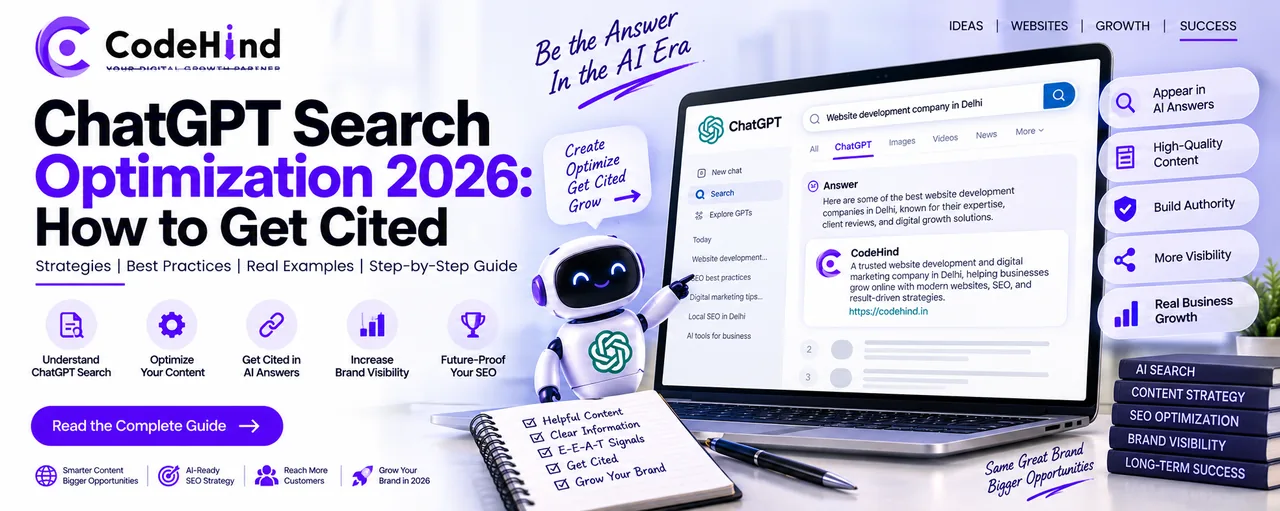
ChatGPT Search and Perplexity are now processing billions of queries that previously went to Google. For brands that want to capture AI-mediated discovery holistically, optimizing only for Google leaves significant visibility on the table.
"Share of Model" is emerging as a real metric — how often your brand name appears in AI-generated answers across all platforms, not just Google. Tracking this (through manual testing and emerging AI monitoring tools) will become standard practice for forward-thinking agencies and businesses.
Zero-click optimization will become a distinct discipline: designing content that generates brand value and lead intent even when users never visit your website, purely through AI answer citations.
The central point: the skills you build optimizing for Google AI Overviews today — entity clarity, structured content, E-E-A-T, topical depth — are the same skills that will drive AI visibility across every platform for the foreseeable future.
Final Action Plan: 90-Day GEO + SEO Roadmap
Month 1 — Foundation
- Audit your site: identify technical issues (crawl errors, JavaScript-dependent content, Core Web Vitals failures)
- Check your entity consistency: confirm NAP matches across website, Google Business Profile, and top 10 directories
- Implement Organization/LocalBusiness schema on all pages (with sameAs, knowsAbout)
- Add Article schema to your 10 most important blog posts
- Add author names, bios, and Person schema to all authored content
- Create or update your Google Business Profile to 100% completion
Month 2 Content Architecture
- Choose 4–6 core pillar topics for your business
- Audit existing content for topical cluster potential
- Restructure your top 5 pages with answer-first passage format (question H2 → 40–60 word answer → depth)
- Add FAQPage schema to all pages with Q&A content
- Create or publish 2–3 new cluster pages supporting each pillar
- Build internal linking structure across all cluster pages
Month 3 Authority and Monitoring
- Earn 3–5 genuine external mentions (local publications, industry directories, partner sites)
- Publish one piece of original data (a survey, a market analysis, a local study)
- Encourage and respond to 10+ Google reviews from real clients
- Set up quarterly content freshness reviews for priority pages
- Begin manual AI Overview monitoring: test your target queries in Google, ChatGPT, and Perplexity weekly
- Measure baseline: rankings, organic traffic, AI citations and track changes monthly
GEO + AI Overview Optimization Checklist
Content ✓
- Every important page has a named author with verifiable credentials
- Key sections start with a 40–60 word direct answer after a question-form heading
- Content covers the full topic cluster, not just one keyword
- Statistics and claims are cited with links to primary sources
- Publish and update dates are visible and accurate
- Content is free of keyword stuffing and generic AI-sounding phrases
Technical ✓
- Core content renders in HTML (no critical JavaScript dependency)
- Core Web Vitals pass on mobile (LCP, INP, CLS all three)
- HTTPS enabled, no crawl errors, no redirect chains on important pages
- XML sitemap current and submitted to Google Search Console
- Robots.txt not blocking AI crawlers (GPTBot, Google-Extended, PerplexityBot, ClaudeBot)
Schema ✓
- Organization / LocalBusiness schema with complete fields and sameAs
- Article / BlogPosting schema on all authored content
- FAQPage schema on all Q&A sections
- Person schema for all named authors
- datePublished and dateModified accurate and current
Entity ✓
- Business NAP consistent across website, Google Business Profile, and 10+ directories
- Google Business Profile 100% complete with posts, photos, and services
- Social media profiles consistently branded and linked in Organization schema
- 20+ Google reviews from real clients with detailed, keyword-relevant text
Internal Linking ✓
- Every cluster page links to its pillar page
- Every pillar page links to its cluster pages
- Related service pages cross-link naturally
- No orphan pages (pages with zero internal links pointing to them)
FAQ Section (10 Questions Schema-Ready)
Q1: Do I need to rank #1 to appear in Google AI Overviews? No. Research shows roughly 30% of AI Overview citations come from pages outside the first-page organic results. Google's AI retrieves candidate pages broadly and selects sources based on passage quality, entity trust, and content clarity not only ranking position. A well-optimized page at position 8 can outperform a poorly structured page at position 1 for AI citations.
Q2: How long does it take to start appearing in AI Overviews? There's no fixed timeline it depends on your existing authority, content quality, and competition in your topic area. Brands that implement a complete GEO strategy (entity signals, schema markup, topic cluster content, and answer-first formatting) typically begin to see citation results within 2–4 months, with more consistent citation patterns emerging at 6–9 months.
Q3: Can small businesses compete with large brands in AI Overviews? Yes and this is one of the genuinely leveling aspects of AI search. Large-scale citation studies in 2026 have found smaller brands appearing alongside major companies in AI Overviews, often by providing clearer, more specific answers to niche queries. Topical clarity and content extractability matter more than domain age in AI Overview citation selection.
Q4: Does schema markup guarantee AI Overview citations? No. Google has stated there are no special technical requirements beyond standard indexing eligibility. Schema markup is a supporting signal that helps AI systems understand and trust your content faster, but it's not a guaranteed path. It needs to work alongside strong E-E-A-T, topical depth, and content structure.
Q5: What content types work best for AI Overview citations? Informational content that directly answers clear questions performs best how-to guides, definitions, comparison breakdowns, step-by-step processes, and FAQ content. For businesses, service explanation pages and well-structured blog articles covering industry questions are the most common citation sources.
Q6: Should I block AI crawlers from my website? This is your choice, but blocking AI crawlers means you cannot appear in AI-generated search results. Most businesses benefit more from appearing in AI Overviews than from protecting their content from AI training. If you want AI Overview visibility, you need to allow crawlers like GPTBot, ClaudeBot, PerplexityBot, and Google-Extended.
Q7: How is Google AI Overview different from a Featured Snippet? A Featured Snippet pulls an exact passage from one page and displays it with a link. An AI Overview synthesizes information from multiple pages into a new, unified answer with multiple inline citations. The structural and authority requirements overlap, but AI Overviews reward topical depth and entity signals more than Featured Snippets traditionally did.
Q8: Is GEO different from AEO (Answer Engine Optimization)? They're closely related but slightly different in scope. AEO is specifically about getting your content surfaced as direct answers in AI systems — voice search, ChatGPT, Perplexity. GEO is the broader practice of optimizing for generative AI platforms including Google AI Overviews. In practice, the same techniques (answer-first content, schema, entity building, E-E-A-T) apply to both.
Q9: What tools can I use to track my AI Overview citations? As of 2026, dedicated AI citation tracking is still an emerging category. Options include: manual daily testing of your target queries in Google Search, ChatGPT, and Perplexity; Google Search Console (which now shows some AI Overview impression data); and specialized tools like BrightEdge, Conductor, and emerging AI monitoring platforms. There's no single perfect tool yet manual testing remains the most reliable method.
Q10: Does my Google Business Profile affect AI Overviews? Directly, yes. For local queries ("digital marketing agency near me," "SEO company in Rohini"), Google Business Profile data feeds into the local entity signals that AI systems use to surface and cite local businesses. A fully optimized, regularly updated Google Business Profile with consistent NAP, complete service descriptions, and genuine reviews is one of the highest-ROI actions for local business AI visibility.
Internal Linking Suggestions (For a Website Development & SEO Agency)
Link this article naturally to the following pages on your site:
- SEO Services page anchor: "our SEO services for Delhi businesses" or "proven SEO strategies we use for clients"
- Website Development page anchor: "a technically sound, crawlable website" or "fast-loading, mobile-first websites"
- Google Business Profile Optimization page anchor: "Google Business Profile optimization" or "local entity signals"
- Local SEO page anchor: "local SEO for Delhi NCR businesses" or "rank in local search results"
- Blog: GEO vs Traditional SEO anchor: "our earlier breakdown of GEO vs SEO" or "how GEO compares to traditional search optimization"
- Contact/Consultation page anchor: "book a free strategy consultation" (CTA link at article end)
- About Us / Team page anchor: "our experienced digital marketing team" (for E-E-A-T context)
External Authority Sources to Reference in Article:
- Google Search Central (developers.google.com/search) for AI Overview official guidance
- Search Engine Journal for industry data and algorithm updates
- Ahrefs Blog for CTR impact studies
- Conductor / BrightEdge for AI Overview appearance frequency data
- Gartner for traditional search volume projections
- Google's own E-E-A-T documentation (Search Quality Rater Guidelines)
- Schema.org for structured data reference
Featured Snippet Opportunities:
Target these specific queries with dedicated passage blocks (question heading + 50-word answer):
- "What are Google AI Overviews?" definition snippet
- "How does Google choose sources for AI Overviews?" process/list snippet
- "How do I get my website in Google AI Overviews?" step list snippet
- "What is E-E-A-T in SEO?" definition snippet
- "Do you need to rank #1 for AI Overviews?" direct answer (yes/no + explanation)
- "What schema markup helps with AI Overviews?" list snippet
- The comparison table (Traditional SEO vs AI Overview Optimization) table snippet
Ready to Get Your Business Cited in Google AI Overviews?
Understanding GEO strategy is one thing. Implementing it across your website, your content, your technical setup, and your entity ecosystem while running a business is another.
At CodeHind, we work with businesses across Rohini, Pitampura, and all of Delhi NCR to build digital marketing strategies that don't just chase yesterday's algorithm. We optimize for where search is going so you're visible in Google Search, Google AI Overviews, and the AI-powered discovery engines your future customers are using right now.
Your next step is simple:
→ Book Your Free GEO + SEO Consultation with CodeHind
We'll audit your current visibility, identify your biggest AI Overview opportunities, and give you a clear, prioritized action plan no obligation, no jargon, just a real strategy conversation.
CodeHind - Digital Marketing & Website Development Agency, Sector-20, Rohini, New Delhi.